Container preparation
Rinsing, unscrambling, infeed and handling can prepare stable, correctly oriented containers for the process.
Integrated equipment rental
Bring compatible filling, closing, labelling, coding and handling stages together around one product, pack, output and production window.
Discuss a packaging line projectDirect answer
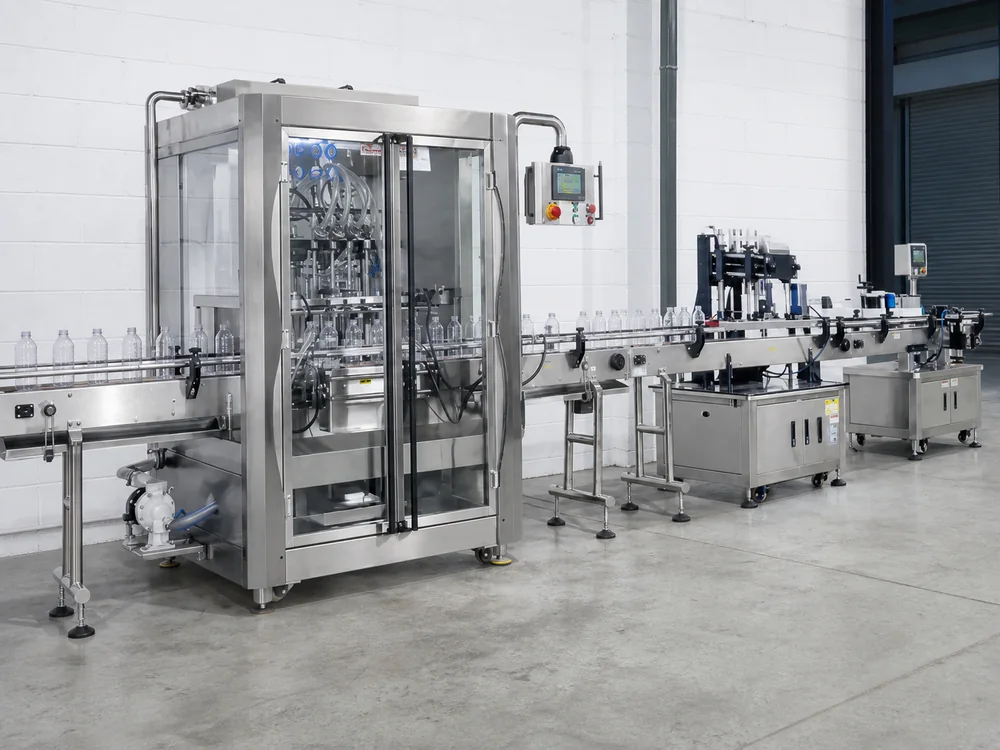
Complete packaging line hire is the temporary rental of multiple compatible machines arranged as one production process. A project can combine filling, capping, sealing, labelling, coding, inspection and conveying, subject to application, site and availability.
Integration warning: a group of individually suitable machines does not automatically make a suitable line. Product transfer, speed, controls, accumulation, guarding and operator access must work together.
Provide the product, every packaging component, target output, changeovers, proposed layout, utilities, access, existing interfaces and the complete production timetable.
Potential line stages
Rinsing, unscrambling, infeed and handling can prepare stable, correctly oriented containers for the process.
The filler must match product behaviour, contact requirements, pack opening, volume or weight and required accuracy.
Filling machine hireClosure geometry, feeding, torque, container stability and line speed determine the capping arrangement.
Capping machine hireProduct presentation, label construction, print area and inspection needs affect downstream configuration.
Coding machine hireCompatible conveyor sections control transfer, spacing and temporary accumulation between process stages.
Packaging conveyor hireInduction sealing, shrink wrapping or other finishing stages may be reviewed where the pack and process are suitable.
Induction sealer hireLine engineering questions
Project use cases
Integrated rental can support a contract packing project, launch run, seasonal campaign, temporary factory layout, extended trial or capacity requirement that cannot be met by one standalone machine.
It needs more planning lead time than an isolated machine because the equipment, logistics, utilities and interfaces must be defined together.
Plan the rental process
Packaging line questions
A project may combine compatible filling, capping, sealing, labelling, coding, inspection and conveyor equipment. The exact scope depends on the product, pack, output, site and available machinery.
Potentially, but conveyor height, product transfer, speed, controls, guarding and responsibilities at each interface need to be reviewed and agreed.
Provide a layout, access and offloading details, floor and footprint information, power and compressed air availability, environment, existing line interfaces, postcode and production dates.
Possibly. Each product and pack combination needs to be assessed for tooling, change parts, settings, cleaning, changeover time and the available operating range.
Define the whole process
Send the process, pack, output, site layout and timing requirements.
For a hypothetical 12,000-pack campaign with six hours available for actual packing, the required accepted output is about 33.3 packs per minute. If two of those hours are instead needed for setup, cleaning and format changes, the remaining four hours require 50 accepted packs per minute. These are planning examples, not equipment ratings; agree which activities sit inside the production window.
List where a container can wait safely: before filling, after closing and before final packing. A downstream pause can fill a conveyor before the upstream station has finished its current cycle. Review how the line stops, contains work in progress and restarts without mixing accepted and unchecked packs. Accumulation is a finite allowance, not a cure for a slower downstream process.
For each connection, identify the mechanical transfer, product support, operating signals, safeguarding boundary and person responsible for proving it. Include the customer-owned equipment and any manually staffed station. Treat a missing owner as an open action, even where each individual machine has already been accepted separately.
Agree a representative product run, planned replenishment, format change and controlled stop/restart for commissioning. Record accepted packs, rejects, operator interventions and remaining actions against the agreed criteria. Confirm the approved operating and isolation procedures before use. The conveyor hire route and hire process help define the installation and return scope.